
If I asked you to name the most important organ for your mental health, you’d probably say your brain. And you’d probably be right. But if I asked what you do every single day that directly affects your brain’s ability to regulate mood, manage stress, maintain focus, and produce the neurochemicals that keep you feeling stable — many people wouldn’t think of the answer immediately.
It’s food.
What you eat has a direct, measurable impact on how you feel mentally and emotionally. This isn’t wellness culture hype or a pitch for a restrictive diet. It’s an increasingly robust body of clinical evidence showing that dietary patterns influence depression, anxiety, cognitive function, sleep quality, and overall mental resilience. And yet, nutrition is one of the most overlooked dimensions of mental health care.
As a dual-certified psychiatric and family nurse practitioner, I sit at the intersection of mental and physical health — and I see the connection between the two every day in my practice. When a client comes to me with depression that hasn’t fully responded to medication, or anxiety that spikes unpredictably, or fatigue that seems disproportionate to their lifestyle, one of the first things I explore is what’s happening nutritionally. Not because food is a replacement for clinical treatment, but because it’s a foundational piece that, when missing, makes everything else harder.
In this guide, I’ll walk you through what the research says about the relationship between nutrition and mental health, how specific nutrients affect your brain, practical ways to nourish yourself for emotional wellbeing, and how I integrate nutritional guidance into the holistic care I provide at InnerClarity Psychiatry & Wellness.
The Research Is Clear: Diet Affects Mental Health
The field of nutritional psychiatry has grown rapidly over the past decade, producing evidence that is too consistent to ignore.
The landmark study in this space is the SMILES trial — a randomized controlled trial published in BMC Medicine that examined whether dietary improvement could reduce symptoms of clinical depression. Participants who adopted a modified Mediterranean diet (rich in vegetables, fruits, whole grains, legumes, nuts, fish, and olive oil) experienced significantly greater improvement in depressive symptoms compared to a social support control group over 12 weeks (Jacka et al., 2017). This was not a study of mildly unhappy people eating more salad. These were individuals with diagnosed moderate-to-severe depression, and dietary change produced measurable clinical improvement.
A large meta-analysis published in Psychosomatic Medicine reinforced these findings, concluding that healthy dietary patterns are associated with significantly reduced risk of depression, while dietary patterns high in processed food, refined sugar, and saturated fat are associated with increased risk (Lassale et al., 2019). A separate review in Molecular Psychiatry found that the Mediterranean diet was associated with a 33% lower risk of developing depression compared to a standard Western diet (Psaltopoulou et al., 2013).
The evidence extends beyond depression. Research has linked dietary quality to anxiety symptoms, cognitive performance, sleep quality, and even the risk of neurodegenerative disease. Your diet is not everything — but it is a significant, modifiable factor that interacts with every other aspect of your mental health treatment.
How Food Affects Your Brain: The Mechanisms
Understanding why food affects mood requires understanding a few key mechanisms.
The Gut-Brain Axis
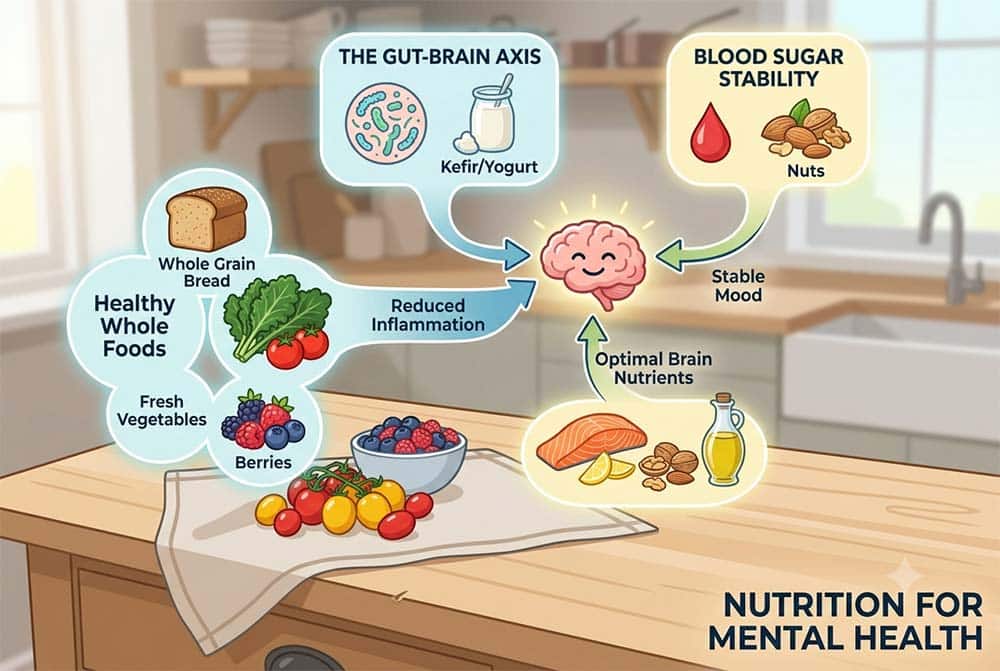
Your gut and your brain are in constant communication through a network known as the gut-brain axis. The gut produces approximately 90–95% of the body’s serotonin — the same neurotransmitter targeted by most antidepressant medications (Yano et al., 2015). It also produces other neurochemicals involved in mood regulation, including dopamine and GABA.
The health of your gut microbiome — the trillions of bacteria that live in your digestive system — directly influences this production. A diet rich in fiber, fermented foods, and diverse plant matter supports a healthy microbiome. A diet high in processed foods, artificial sweeteners, and refined sugar disrupts it. When your gut microbiome is compromised, so is its ability to produce the neurochemicals your brain depends on for emotional stability.
Inflammation
Chronic, low-grade inflammation has emerged as a significant contributor to depression, anxiety, and cognitive decline. Research published in JAMA Psychiatry found elevated inflammatory markers in individuals with depression compared to non-depressed controls (Osimo et al., 2019). Certain dietary patterns — particularly those heavy in processed foods, trans fats, refined carbohydrates, and excess sugar — promote systemic inflammation. Anti-inflammatory dietary patterns (like the Mediterranean diet) have the opposite effect, helping to calm the body’s inflammatory response and, by extension, support mental health.
Blood Sugar Regulation
Your brain is extremely sensitive to fluctuations in blood glucose. Rapid spikes and crashes — the kind produced by high-sugar, low-fiber meals — can trigger or worsen anxiety symptoms, irritability, fatigue, difficulty concentrating, and mood instability. Stable blood sugar, achieved through balanced meals that include protein, healthy fats, and complex carbohydrates, provides the brain with a steady fuel supply and helps maintain emotional equilibrium.
Nutrient Deficiencies
Specific nutrient deficiencies are directly linked to mental health symptoms. Among the most well-documented are vitamin D, which plays a role in serotonin synthesis and has been linked to depression risk in multiple studies; B vitamins (particularly B12 and folate), which are essential for neurotransmitter production and nervous system function; iron, whose deficiency can cause fatigue, cognitive impairment, and mood changes; omega-3 fatty acids, which support brain cell membrane integrity and have demonstrated anti-inflammatory and antidepressant effects; and magnesium, which plays a role in stress response regulation and sleep quality.
This is one of the reasons I may recommend targeted lab testing for my clients — because if a vitamin D deficiency is contributing to your depression, or an iron deficiency is driving your fatigue, no amount of therapy or medication alone will fully resolve the issue. Identifying and correcting the deficiency changes the equation.
What Nutritional Mental Health Looks Like in Practice
Nutritional psychiatry is not about prescribing a rigid diet. It’s about understanding how your current eating patterns may be affecting how you feel, and making sustainable, realistic shifts that support your brain and body together.
The Foods That Support Mental Health
The dietary patterns most consistently associated with better mental health outcomes share common elements: abundant vegetables and fruits (especially leafy greens, berries, and colorful produce), whole grains (oats, brown rice, quinoa, whole wheat), lean proteins (fish, poultry, legumes, eggs), healthy fats (olive oil, avocado, nuts, seeds, fatty fish like salmon and sardines), fermented foods (yogurt, kefir, kimchi, sauerkraut) that support gut microbiome diversity, and adequate hydration.
The Patterns That Undermine Mental Health
On the other side, the dietary patterns most frequently associated with worse mental health outcomes involve high intake of ultra-processed foods, excess refined sugar and artificial sweeteners, trans fats and fried foods, low fiber intake, excessive caffeine (which can amplify anxiety), and excessive alcohol (which disrupts sleep, depletes nutrients, and worsens depression).
A Realistic Approach
I want to be clear about something: I do not prescribe perfection. If you’re struggling with depression, the last thing you need is guilt about eating a bowl of pasta. Nutritional guidance in my practice is gentle, non-restrictive, and grounded in curiosity rather than judgment. We explore what you’re currently eating, how it might be affecting your mood and energy, and what small, doable shifts could make a meaningful difference — without adding more pressure to a life that may already feel overwhelming.
Sometimes it starts with something as simple as adding a protein-rich breakfast instead of skipping meals. Or drinking more water. Or replacing one processed snack with a handful of nuts. These are not dramatic changes, but they compound over time.
How I Integrate Nutrition into Psychiatric Care
At InnerClarity Psychiatry & Wellness, nutritional guidance is woven into the fabric of holistic care — not treated as a separate service or an afterthought.
During your assessment, I ask about your eating patterns, energy levels, cravings, and relationship with food. If nutritional factors may be contributing to your symptoms, I may recommend lab testing to identify deficiencies (vitamin D, B12, iron, folate, thyroid function, inflammatory markers) and then address findings through dietary guidance and, when appropriate, evidence-based nutraceuticals — professional-grade supplements selected based on your lab results and clinical picture.
Nutritional support complements — it does not replace — other elements of your treatment plan, including medication management, supportive therapy, and lifestyle strategies. But in my experience, when nutrition is addressed alongside these other interventions, the results are more complete and more sustainable.
Frequently Asked Questions About Nutrition and Mental Health
Can changing my diet really help with depression or anxiety?
Research strongly suggests that dietary patterns influence depression and anxiety risk and symptom severity. The SMILES trial demonstrated that dietary improvement produced clinically significant reductions in depressive symptoms in individuals with diagnosed depression (Jacka et al., 2017). Diet is not a replacement for clinical treatment, but it is a meaningful, evidence-based complement to therapy and medication.
Do I need to follow a specific diet?
No. There is no single required diet for mental health. The patterns most consistently associated with benefit are Mediterranean-style eating patterns — rich in whole foods, healthy fats, lean proteins, and fiber. But the goal is progress, not perfection. Even small improvements in dietary quality can produce noticeable changes in mood and energy.
What about supplements — do they help?
Evidence-based supplements can be helpful when they’re addressing a documented deficiency or supporting a specific clinical need. I do not recommend supplements as a blanket approach. Instead, I use lab testing to identify what your body actually needs and then select targeted, professional-grade options. This ensures that supplementation is specific, safe, and clinically grounded.
I eat well but still feel terrible. What’s going on?
Nutrition is one factor among many. If you’re eating well but still struggling with depression, anxiety, or fatigue, other factors — sleep quality, stress levels, hormonal imbalances, medication interactions, underlying medical conditions, or unresolved psychological concerns — may be contributing. A comprehensive assessment that looks at the full picture is the best way to identify what’s driving your symptoms.
Does InnerClarity Psychiatry & Wellness offer weight management support?
Yes. I provide weight management services that integrate nutritional guidance, lifestyle coaching, behavioral support, and medication when clinically appropriate. My approach is gentle, non-restrictive, and focused on sustainable change that supports both your physical and mental health. Visit my Physical Health & Wellness page for more details.
Nourishing Your Brain Is an Act of Self-Care
If you’ve been managing depression, anxiety, burnout, or chronic fatigue and haven’t explored how nutrition might be playing a role, this is your invitation to start. Not with a radical diet overhaul — but with curiosity. What are you eating? How does it make you feel? What would it look like to give your brain a little more of what it needs?
At InnerClarity Psychiatry & Wellness, I provide integrative, whole-person telepsychiatric care to individuals across Minnesota and Iowa. Nutritional guidance, lab testing, and supplement support are part of the holistic approach I bring to care— because your brain is part of your body, and treating them as separate systems misses the full picture.
If you’re ready to explore how nutrition fits into your mental health care, request a consultation at InnerClarity Psychiatry & Wellness today.
References
Jacka, F. N., O’Neil, A., Opie, R., et al. (2017). A Randomised Controlled Trial of Dietary Improvement for Adults with Major Depression (the SMILES trial). BMC Medicine, 15(1), 23.
Lassale, C., Batty, G. D., Baghdadli, A., et al. (2019). Healthy Dietary Indices and Risk of Depressive Outcomes: A Systematic Review and Meta-Analysis of Observational Studies. Molecular Psychiatry, 24(7), 965–986.
Osimo, E. F., Baxter, L. J., Lewis, G., et al. (2019). Prevalence of Low-Grade Inflammation in Depression: A Systematic Review and Meta-Analysis of CRP Levels. Psychological Medicine, 49(12), 1958–1970.
Psaltopoulou, T., Sergentanis, T. N., Panagiotakos, D. B., et al. (2013). Mediterranean Diet, Stroke, Cognitive Impairment, and Depression: A Meta-Analysis. Annals of Neurology, 74(4), 580–591.
Yano, J. M., Yu, K., Donaldson, G. P., et al. (2015). Indigenous Bacteria from the Gut Microbiota Regulate Host Serotonin Biosynthesis. Cell, 161(2), 264–276.
Disclaimer
This blog post is for educational and informational purposes only and is not intended as a substitute for professional medical advice, diagnosis, or treatment. Always consult a qualified healthcare provider with any questions you may have regarding a mental health condition. Do not disregard professional advice or delay seeking treatment based on information presented in this blog.
If you or someone you know is in crisis or experiencing thoughts of self-harm or suicide, please contact the 988 Suicide & Crisis Lifeline by calling or texting 988 (available 24/7). For immediate safety emergencies, call 911 or go to your nearest emergency room.
ABOUT THE AUTHOR

Aicha Katty, DNP, APRN, PMHNP-BC, FNP-C, is the founder of InnerClarity Psychiatry & Wellness, a telepsychiatry practice serving individuals across Minnesota and Iowa. She holds a Doctor of Nursing Practice from Winona State University and dual board certifications in psychiatric mental health and family practice.
With a clinical background that spans both psychiatry and family medicine, Aicha brings a whole-person lens to mental health care — including the often-overlooked connection between nutrition and emotional wellbeing. She integrates nutritional guidance, targeted lab testing, and evidence-based nutraceuticals where appropriate into her practice alongside medication management, supportive therapy, and lifestyle coaching. Her approach is gentle, non-restrictive, and grounded in the belief that caring for your body is an essential part of caring for your mind.
If you’re curious about how nutrition may be affecting your mental health, request a consultation at InnerClarity Psychiatry & Wellness today.