

You used to love your job. Or at least, you didn’t dread it. Now, the alarm goes off and your first thought is “I can’t do this anymore.” The tasks that used to feel manageable now feel impossible. You’re short with the people you love. You’ve stopped doing the things that used to bring you joy — not because you lost interest, but because you simply don’t have anything left to give. You might be sleeping more than usual and still waking up exhausted. Or you might lie awake at night, mind churning through an endless list of things that didn’t get done.
If this is your reality, you’re not weak. You’re not lazy. And you’re not alone. What you’re experiencing may be burnout — and it is far more than just being tired.
Burnout is a state of chronic physical, emotional, and mental exhaustion caused by prolonged, unrelenting stress. The World Health Organization recognized it in the International Classification of Diseases (ICD-11) as an occupational phenomenon resulting from chronic workplace stress that has not been successfully managed (WHO, 2019). But in my clinical experience, burnout doesn’t stay in the workplace. It spills into every corner of your life — your relationships, your parenting, your health, your sense of self.
As a psychiatric nurse practitioner who works with young adults, professionals, women, and mothers across Minnesota and Iowa, burnout is one of the conditions I see most frequently. And as someone who has personally navigated burnout during my own educational and professional journey, I understand how isolating it can feel — especially when the world expects you to keep performing.
The Three Dimensions of Burnout
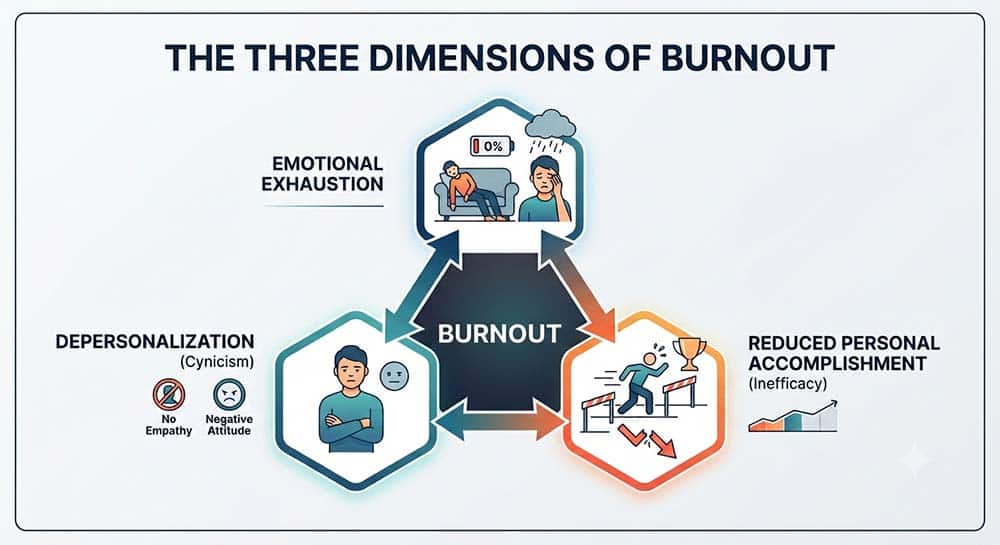
Burnout is not a single feeling. Research by Christina Maslach, the psychologist whose work has defined burnout for decades, identifies three core dimensions that distinguish burnout from ordinary stress or fatigue (Maslach & Leiter, 2016).
Emotional exhaustion is the hallmark. It’s the feeling of being completely drained — not just physically tired, but emotionally depleted. You have nothing left to give. Simple interactions feel effortful. You may find yourself crying for reasons you can’t articulate, or feeling numb when you know you should feel something.
Depersonalization and detachment is the second dimension. You start pulling away — from colleagues, from loved ones, sometimes from yourself. You may notice increased cynicism, irritability, or a sense of going through the motions without actually being present. In caregiving professions, this can manifest as emotional distance from the people you’re supposed to be helping.
Reduced personal accomplishment is the third. Despite working harder than ever, you feel like nothing you do matters or makes a difference. Your confidence erodes. You question your competence. You may feel like a fraud — a pattern that frequently overlaps with impostor syndrome.
When all three dimensions are present, you’re not just stressed. You’re burned out.
Burnout vs. Depression: An Important Distinction
One of the most common clinical challenges with burnout is distinguishing it from depression. The symptoms overlap significantly — fatigue, difficulty concentrating, sleep disruption, irritability, loss of motivation, withdrawal from activities.
The key difference lies in context and trajectory. Burnout is typically tied to a specific, identifiable source of chronic stress — work demands, caregiving responsibilities, financial pressure, academic load. When that source is removed or significantly reduced, burnout symptoms tend to improve. Depression, by contrast, is a pervasive mood disorder that affects all areas of life and does not necessarily improve with environmental changes alone.
However, the relationship between burnout and depression is not always clean. Prolonged burnout can trigger a depressive episode. A study published in Annals of Behavioral Medicine found that chronic burnout is a significant risk factor for the development of clinical depression (Ahola et al., 2005). This means that burnout left unaddressed doesn’t just stay as burnout — it can evolve into something deeper.
This is why I take burnout seriously as a clinical concern, not just a lifestyle issue. And it’s why a thorough assessment is important — because the right treatment depends on accurately understanding what’s happening.
Who Burns Out and Why
Burnout can affect anyone under sustained stress, but certain populations are disproportionately vulnerable.
Women and mothers carry a particularly heavy burden. Research consistently shows that women are more likely to experience burnout than men, driven in part by the “second shift” — the unpaid domestic and caregiving labor that continues after the workday ends (Hochschild & Machung, 2012). Mothers, especially, navigate the impossible math of meeting professional expectations while being emotionally present for their children, managing household logistics, and leaving nothing for themselves. Maternal burnout is one of the most common presentations — and one of the least recognized, because exhausted mothers are often told they should simply be grateful rather than struggling.
Young adults and early-career professionals face burnout driven by the pressure to establish themselves, student loan stress, social comparison amplified by social media, and the gap between the career they imagined and the reality they’ve entered.
Caregivers — whether caring for aging parents, a chronically ill partner, or a child with special needs — are at significant risk because the demands are relentless and the breaks are rare.
Healthcare workers, educators, and first responders experience burnout at elevated rates due to the emotional intensity and systemic demands of their work.
What these groups have in common is not weakness — it’s the combination of high demands, limited control, and insufficient recovery. Burnout is a systems problem as much as it is a personal one.
The Physical Cost of Burnout
Burnout doesn’t just live in your mind — it lives in your body. Chronic stress drives sustained elevation of cortisol (the body’s primary stress hormone), which over time can disrupt virtually every system in the body. A meta-analysis published in Psychoneuroendocrinology found that burnout is associated with dysregulated cortisol patterns, elevated inflammatory markers, and increased cardiovascular risk (Danhof-Pont et al., 2011).
In practical terms, this means burnout can contribute to chronic headaches and muscle tension, gastrointestinal issues, weakened immune function (getting sick more often), disrupted sleep architecture, weight changes, hormonal imbalances, and increased risk of cardiovascular events.
These physical symptoms are not “all in your head.” They are the physiological consequences of a nervous system that has been running in overdrive for too long without adequate recovery.
Recovering from Burnout: What Actually Helps
Recovery from burnout is possible, but it requires more than a vacation or a good night’s sleep. Burnout develops over time, and it resolves over time — through deliberate, sustained changes.
Recognize and Name It
The first step is recognizing that what you’re experiencing is burnout — not laziness, not ingratitude, not a character flaw. Naming it accurately allows you to stop blaming yourself and start addressing the actual problem.
Identify the Source
Burnout has a source. It may be your workload, your caregiving responsibilities, a toxic environment, financial pressure, or the cumulative weight of doing too much for too long. Identifying the primary drivers allows you to make targeted changes rather than vague resolutions to “do less.”
Rebuild Boundaries
Burnout almost always involves a boundary deficit — giving more than you have, saying yes when your body is screaming no, absorbing others’ needs at the expense of your own. Rebuilding boundaries is not selfish. It’s the structural foundation for sustainable wellbeing. This might mean renegotiating your workload, delegating responsibilities, setting time limits on availability, or simply learning to tolerate the discomfort of disappointing someone in order to protect yourself.
Prioritize Recovery, Not Just Rest
Rest and recovery are not the same thing. Rest is lying on the couch. Recovery is actively replenishing what burnout depleted — connection, meaning, joy, physical vitality. This may include reconnecting with hobbies or activities that nourish you, spending time with people who energize rather than drain you, engaging in physical movement that feels restorative rather than punishing, and investing in sleep hygiene to support your brain’s capacity to heal.
Address the Underlying Factors
If burnout has triggered or coexists with depression, anxiety, or insomnia, those conditions benefit from clinical attention. Medication, when appropriate, can help stabilize symptoms enough for you to engage in the deeper work of restructuring your life. Supportive therapy provides a space to process the emotional toll and develop strategies for preventing recurrence. Lifestyle coaching — nutrition, sleep, movement, stress management — rebuilds the physical foundation that burnout erodes.
Get Professional Support
You don’t have to figure this out alone. A provider who understands burnout — not as a buzzword, but as a serious clinical concern with real physiological consequences — can help you build a comprehensive recovery plan tailored to your specific situation.
Frequently Asked Questions About Burnout
Is burnout a medical diagnosis?
Burnout is recognized by the World Health Organization as an occupational phenomenon in the ICD-11, though it is not classified as a medical condition in the same way depression or anxiety are. In clinical practice, burnout is taken seriously as a significant contributor to mental and physical health problems and is often addressed alongside conditions like depression, anxiety, and insomnia.
Can burnout cause depression?
Yes. Research shows that chronic burnout is a significant risk factor for developing clinical depression. The two conditions share many symptoms, and prolonged burnout can evolve into a depressive episode if not addressed. A thorough clinical assessment can help distinguish between the two and guide appropriate treatment.
How long does it take to recover from burnout?
There is no universal timeline. Recovery depends on the severity and duration of burnout, the sources of stress, and what changes you’re able to make. Some individuals begin feeling improvement within weeks of making meaningful shifts. Others need months of sustained effort, especially if burnout has triggered depression or anxiety. The key is consistency and patience — recovery is a process, not an event.
I feel burned out, but I can’t change my job or quit caregiving. What can I do?
This is one of the most common and valid concerns I hear. When you can’t remove the source of stress, the focus shifts to how you manage within it — rebuilding boundaries, reclaiming small pockets of recovery, addressing sleep and nutrition, and developing coping strategies that protect your emotional reserves. Professional support can help you build these tools even when the external circumstances are not easily changed.
How is burnout treated at InnerClarity?
I approach burnout as a whole-person concern — not just a productivity problem. Treatment may include supportive therapy to process the emotional toll, lifestyle coaching to rebuild boundaries and recovery habits, nutritional and sleep optimization, and medication when burnout has triggered or coexists with depression, anxiety, or insomnia. We build a plan around your actual life — not a theoretical ideal.
You Deserve More Than Survival Mode
Burnout convinces you that this is just how life is. That exhaustion is normal. That everyone feels this way. But chronic depletion is not a sustainable way to live, and you deserve more than getting through each day on fumes.
At InnerClarity Psychiatry & Wellness, I provide personalized, holistic telepsychiatric care to individuals across Minnesota and Iowa who are navigating burnout, depression, anxiety, and the complex interplay between them. Whether you need help disentangling burnout from depression, rebuilding boundaries and recovery habits, or simply finding a provider who takes your exhaustion seriously — I am here.
If burnout has been running your life, request a consultation at InnerClarity Psychiatry & Wellness and let’s build a path back to yourself.
References
Ahola, K., Honkonen, T., Isometsä, E., et al. (2005). The Relationship Between Job-Related Burnout and Depressive Disorders. Journal of Affective Disorders, 88(1), 55–62.
Danhof-Pont, M. B., van Veen, T., & Zitman, F. G. (2011). Biomarkers in Burnout: A Systematic Review. Journal of Psychosomatic Research, 70(6), 505–524.
Hochschild, A. R. & Machung, A. (2012). The Second Shift: Working Families and the Revolution at Home. Penguin Books.
Maslach, C. & Leiter, M. P. (2016). Understanding the Burnout Experience: Recent Research and Its Implications for Psychiatry. World Psychiatry, 15(2), 103–111.
World Health Organization. (2019). Burn-out an “Occupational Phenomenon”: International Classification of Diseases.
Disclaimer
This blog post is for educational and informational purposes only and is not intended as a substitute for professional medical advice, diagnosis, or treatment. Always consult a qualified healthcare provider with any questions you may have regarding a mental health condition. Do not disregard professional advice or delay seeking treatment based on information presented in this blog.
If you or someone you know is in crisis or experiencing thoughts of self-harm or suicide, please contact the 988 Suicide & Crisis Lifeline by calling or texting 988 (available 24/7). For immediate safety emergencies, call 911 or go to your nearest emergency room.
ABOUT THE AUTHOR

Aicha Katty, DNP, APRN, PMHNP-BC, FNP-C, is the founder of InnerClarity Psychiatry & Wellness, a telepsychiatry practice serving individuals across Minnesota and Iowa. She holds a Doctor of Nursing Practice from Winona State University and dual board certifications in psychiatric mental health and family practice.
Burnout is one of the most common conditions Aicha treats in her practice, particularly among young adults, women, and working professionals navigating the competing demands of professional and personal life. Having experienced burnout herself during her educational and professional journey, Aicha brings both clinical expertise and personal understanding to every client navigating chronic exhaustion, depletion, and the question of how to rebuild a sustainable life. Her approach integrates evidence-based medication management, supportive therapy, lifestyle optimization, and culturally informed care.
If burnout has left you running on empty, request a consultation at InnerClarity Psychiatry & Wellness today.